

Introduction
Stock market updates are an important part of daily financial life for investors, traders, business owners, and even students who want to understand how money moves in the economy. In simple words, stock market updates tell us what is happening in the market right now and why prices are going up or down. These updates help people make better decisions, avoid common mistakes, and stay confident during market ups and downs.
For beginners, stock market updates may look confusing at first. Numbers, charts, and headlines can feel overwhelming. However, once you understand how to read and use updates, they become very useful. For intermediate investors, regular updates help improve timing, strategy, and risk control. That is why learning how to follow stock market updates correctly is a valuable skill.
What is Stock Market Updates?
Stock market updates are regular reports or information that show the current condition of the stock market. They include changes in stock prices, market indexes, trading volume, and overall market trends. These updates can be daily, weekly, or even live during trading hours.
In most cases, stock market updates cover major indexes, top-performing stocks, losing stocks, and important financial news. They also explain why the market is moving in a certain direction. For example, an update may say the market went up because of strong company earnings or fell due to global uncertainty.
Stock market updates are not only for professionals. Anyone interested in investing can use them. They help you understand market behavior and connect news events with price changes. Over time, reading updates builds knowledge and confidence.
Simply put, stock market updates act like a daily health report of the market. They show whether the market is strong, weak, or stable, and what factors are influencing it.
Why is Stock Market Updates Important?
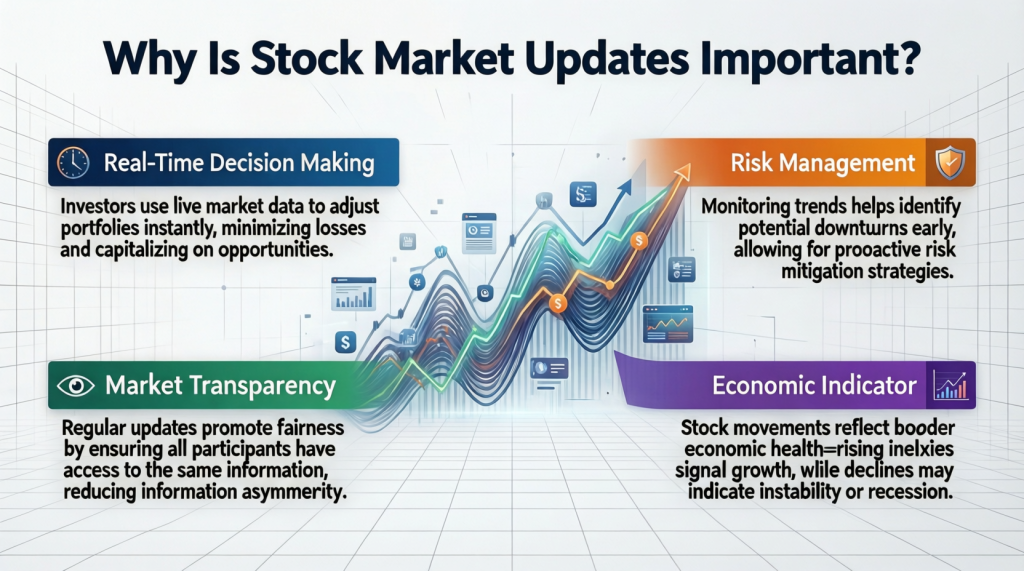
Stock market updates are important because they reduce uncertainty. When you know what is happening in the market, you are less likely to panic or make emotional decisions.
For beginners, updates provide learning opportunities. You can see how news affects prices and understand basic market reactions. For intermediate investors, updates help refine strategies and improve entry or exit timing.
Stock market updates also support risk management. If the market shows signs of weakness, investors can act carefully. If trends look positive, they can plan opportunities wisely.
Another key reason is awareness. Markets are influenced by many factors like inflation, interest rates, company results, and global events. Stock market updates bring these factors together in a clear way.
In short, following updates helps you stay informed, prepared, and confident in your investing journey.
Detailed Step-by-Step Guide
Step 1: Understand Market Indexes
Market indexes show overall market performance. Examples include broad market indexes and sector-based indexes. When indexes rise, the market is generally positive. When they fall, the market is under pressure.
Always start your stock market updates by checking index movement.
Step 2: Track Top Gainers and Losers
Stock market updates usually list stocks with the biggest gains and losses. These lists show which companies are attracting attention.
Look for reasons behind the movement, such as earnings results or major announcements.
Step 3: Read Market News Headlines
Headlines explain why prices change. Economic data, policy decisions, and global events often affect the market.
Focus on major news that impacts many companies, not just one stock.
Step 4: Observe Trading Volume
Volume shows how many shares are traded. High volume with price movement indicates strong interest.
Stock market updates often mention unusual volume activity, which can signal trend changes.
Step 5: Analyze Market Trends
Updates often describe trends like bullish, bearish, or sideways. Understanding trends helps align your strategy with market direction.
Do not trade against strong trends without a clear plan.
Step 6: Connect Updates with Your Goals
Use stock market updates to support your personal goals. Long-term investors focus on stability, while short-term traders focus on daily movement.
Always match updates with your risk level and time horizon.
Benefits of Stock Market Updates
- Help investors stay informed about daily market movements
- Improve decision-making by reducing guesswork
- Support better timing for buying or selling
- Increase understanding of market behavior
- Build confidence for beginners and intermediate investors
- Encourage disciplined and planned investing
Disadvantages / Risks
- Too much information can cause confusion
- Short-term updates may encourage overtrading
- Emotional reactions to negative news
- Misinterpretation of headlines without context
- Dependence on updates without personal research
Common Mistakes to Avoid
One common mistake is reacting emotionally to every stock market update. Not every market move requires action. Another mistake is focusing only on price and ignoring reasons behind the movement.
Some investors rely on updates without checking their own goals. Others follow market noise instead of long-term trends. Avoid making decisions based on fear or excitement.
Lastly, ignoring risk management while following updates can lead to losses. Updates should guide decisions, not control them.
FAQs
What are stock market updates used for?
Stock market updates are used to understand daily market movements and make informed investment decisions.
Are stock market updates useful for beginners?
Yes, they help beginners learn how markets react to news and events.
How often should I check stock market updates?
Checking once or twice a day is enough for most investors.
Can updates predict future prices?
Updates explain current conditions but cannot guarantee future results.
Do long-term investors need daily updates?
Long-term investors can focus on weekly or major updates instead of daily changes.
Are stock market updates always accurate?
They are generally reliable, but investors should always verify information.
Expert Tips & Bonus Points
Always read stock market updates with a calm mindset. Focus on patterns, not single-day movements. Keep a simple notebook to track how news affects prices. Over time, this habit improves understanding.
Combine updates with basic analysis. Do not depend only on headlines. Learn from both positive and negative market days.
Most importantly, stay patient. Stock market updates are tools for learning and guidance, not shortcuts to instant success.
Conclusion
Stock market updates play a vital role in modern investing. They provide clear information about what is happening in the market and why prices move. For beginners, updates act as a learning guide. For intermediate investors, they support smarter and more confident decisions.
By understanding indexes, news, volume, and trends, investors can use stock market updates effectively. The key is to stay calm, focused, and disciplined. Updates should inform your strategy, not control your emotions.